
blind tasting
it's more than a party trick, y'all

Back when the first SOMM movie came out, I wasn’t in the wine industry. Just an enthusiast who wanted to learn more about wine but didn’t know where to jump in because it all felt so overwhelming. In the early parts of the movie, you can see the candidates going through the grid, breaking down a blind wine. And they either nail it or get really really close. Back then, I was amazed like how do they do that? that’s crazy.
Fast forward some years later, and here I am, doing the exact same thing. WILD. When I started working in this industry and discovered wine certifications, I joined a local blind tasting group. This was during the pantene pro-v, so we were meeting over zoom and picking up our 2 oz bottles from a friend’s house. The first couple of meetings I attended, I just observed as others talked their way through their grids. Through this practice, I learned how to decipher different aromas and flavours in wine. As time wore on, I practiced more and more until I became confident enough to contribute out loud. I was wrong a lot of the time, but I learned so much in failing out loud. There were a couple of times when I got lucky - calling a Zinfandel down to producer and vintage, calling a Gruner when everyone else was saying Pinot Grigio, etc. But my biggest lessons have occurred when I was dead wrong.
Now, I do weekly blinds (run by the amazing Janeen Jason - jellybeanneen on IG) that have been super helpful in tuning my palate and preparing me for the beast of the D3 exam. Janeen scores our assessments and gives detailed feedback, which is indispensible to my learning. I post my results every week not to toot my own horn (I seem to land around 40ish points out of a possible 50), but to stay accountable to my studies and to hopefully encourage more wine nerds to make blind tasting a regular practice.
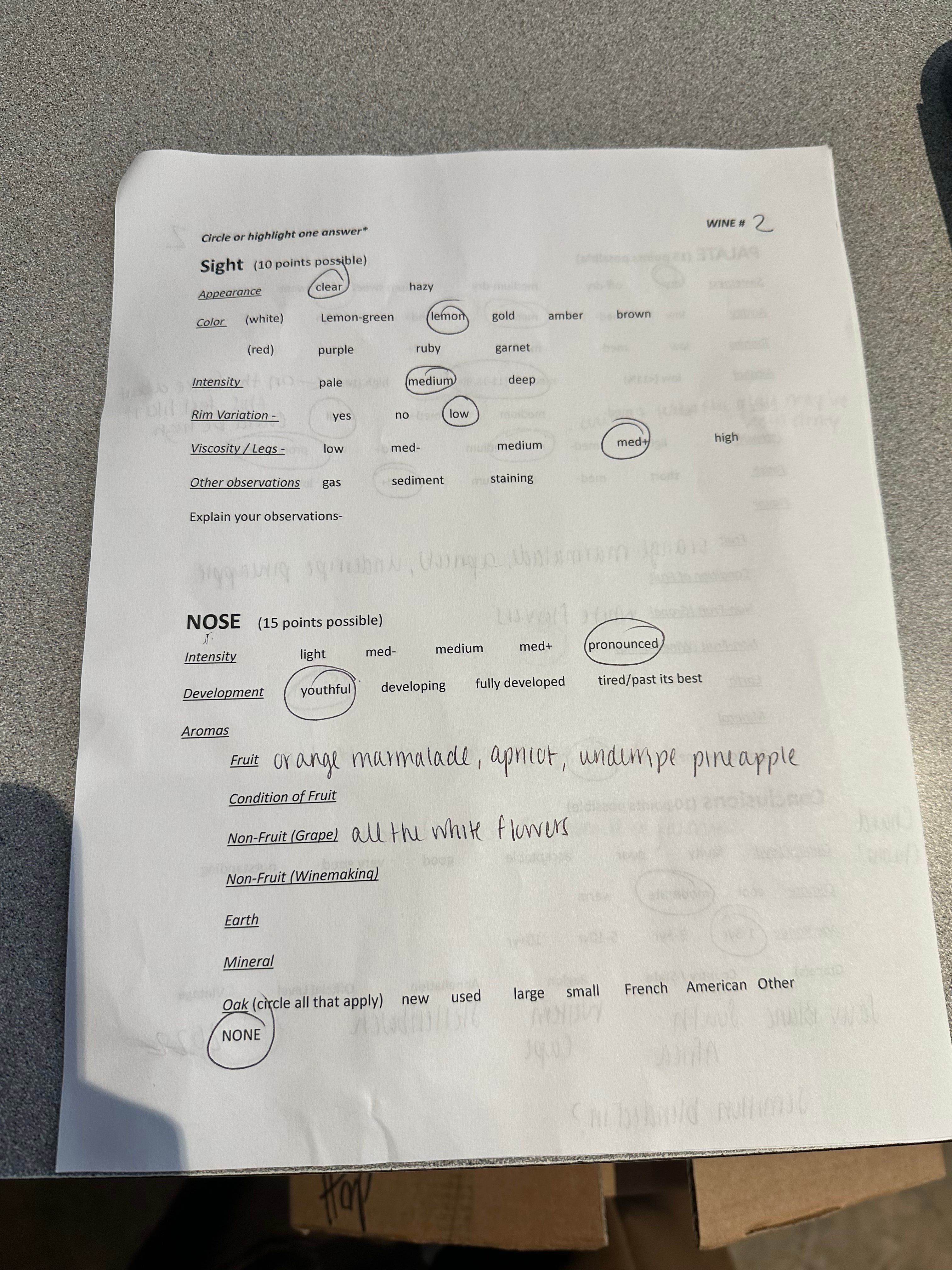
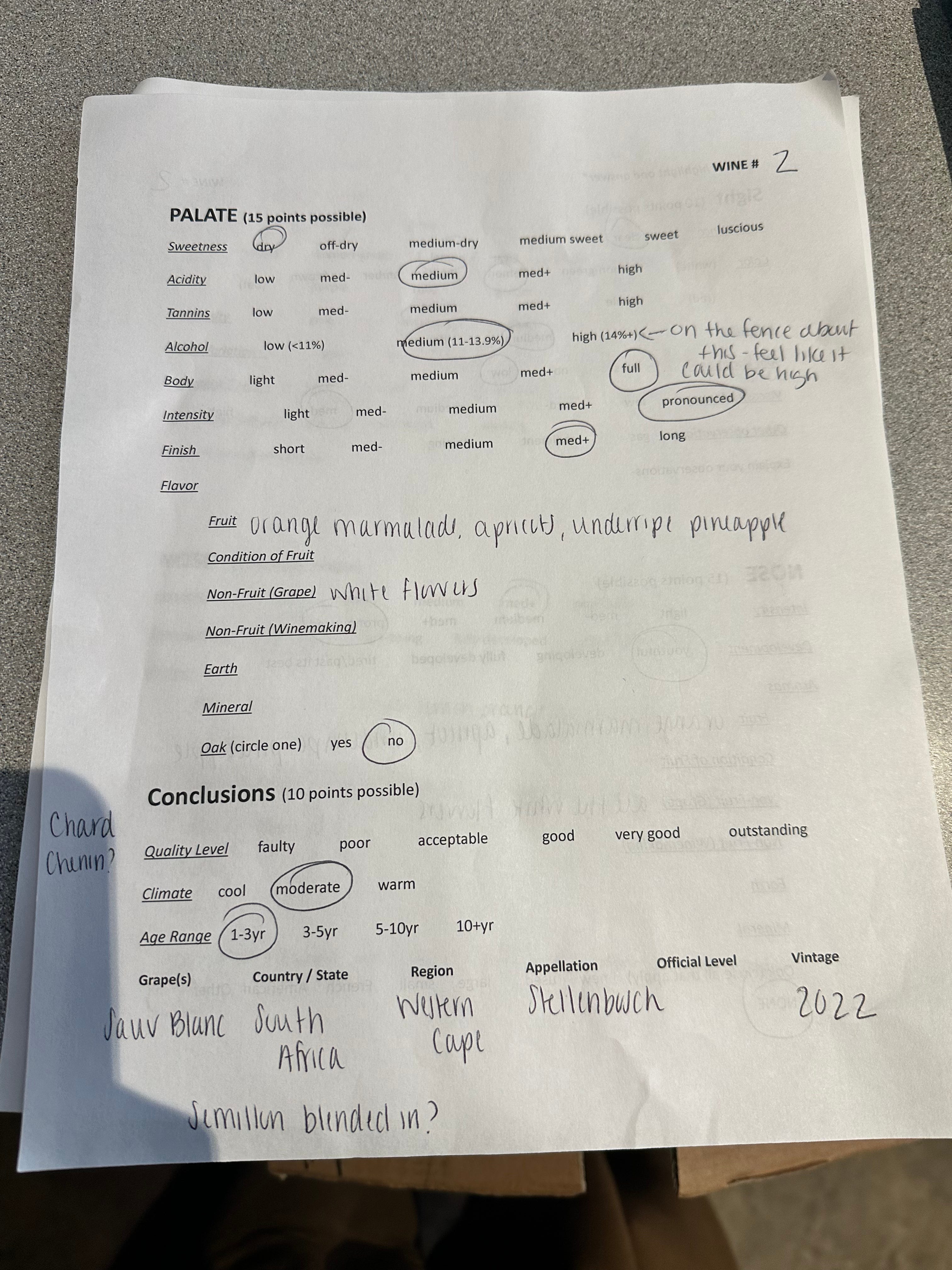
My assessment sheet for one of the wines in a previous flight. You can see on the left of the second picture that my initial calls were Chardonnay and Chenin Blanc. I knew this flight was the same grape variety from four different places, so I just had to get the grape to figure out where in the world these wines were from. It wasn’t until Wine 4 of this flight that I got typical (to me) Sauvignon Blanc notes. This wine was a Graves, not a South African Sauv Blanc. It did have Semillon blended in (yay), but otherwise this wine didn’t present like a typical Bordeaux Blanc (to me). Usually Bordeaux Blanc smells like straight up cat piss. I learned a lot with this particular wine.
but jade, why blind taste, especially if i’m not studying for a wine exam?
I think blind tasting has benefits for everyone - some of which may be a little less apparent than others.
You become a better taster - this sounds obvious, but it’s true. It’s a skill that can be learned, but has to be practiced regularly. How often do we really think about how our food and drink taste on a daily basis? Are we expanding our vocabulary beyond “good” and “bad”? Are we trying to taste the nuance of every dish that is put in front of us? Can we describe the savoury notes? When you’re around folks who taste wine all of the time, you learn more and more vocabulary to add to your arsenal. Yes, I might sound a little crazy saying that a wine smells like lemon curd and butter smeared on whole wheat toast, but it works for me because I can smell and taste all of those components.
Time slows down - this is certainly not true in exam conditions, but when I’m doing these blinds by myself at home, I get to slow down and focus. It can almost be a meditative process as I focus all of my senses on what is in the glass. In a fast-paced world with too many things to do, this blind tasting kit is the perfect way for me to tune out the noise.
It is theory in practice - for those of us who are studying, we get to our final conclusions using theory: grape typicity, regional typicity, climate, winemaking, age, etc. Blind tasting ends up being a great study tool because you can smell and taste what you’re learning. When I approach a white wine with fuller body, I’m immediately asking myself: is this grape typicity like Viognier? Is it bâtonnage? Is it oak? Is it a blend? All of those questions end up leading me to the grape(s) and a part of the world that it may come from.
You build up your arsenal of wines - When I started blind tasting, I hadn’t built up my arsenal of grape varieties, so a lot of my final conclusions were shots in the dark. Is it a high-ABV red? I’m calling it Châteauneuf-du-Pape. Is it a high-acid unoaked white? I’m calling it Chablis. Now that I’ve tasted a lot of wines, I have that arsenal of memory that I can pull from to guide me to a final conclusion. Blinding with a group is also a great way to taste classic producers without committing to an entire bottle.
Any of you out there who wants to start a similar group to what Janeen has, I highly recommend contacting her on IG for details. And know that you can absolutely organise something like this.
Here’s to learning more through blind tasting,
- j
Definitely need to get back into this. SOMMTV also has a series of Blind Tasting that's really good if you haven't seen them. They just put out a new episode this week